Reviewing Single Taken Working Out for Embroidery
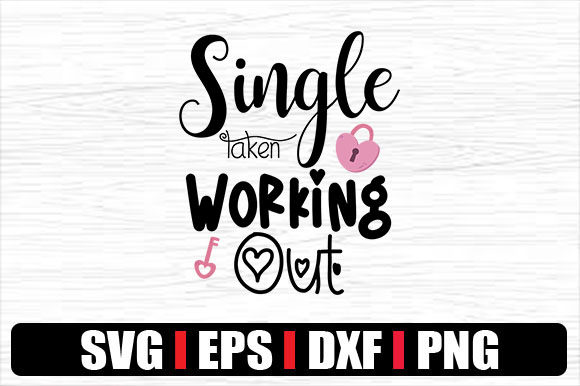
As a designer who spends half my life staring at digitized files and the other half watching needles punch through fabric, I have developed a healthy skepticism toward trendy graphics. We see thousands of designs pass through our workflows every year. Most are forgettable. Some are problematic. But occasionally, a file like Single Taken Working out lands on my desk, and it demands a closer look not just for its aesthetic appeal, but for its practical viability in a real-world production environment.
This isn’t just about whether a design looks cute on a screen. It is about how that design translates when subjected to the mechanical realities of an embroidery machine. Will the satin stitches bridge properly? Is the density manageable on a stretchy cotton blend? Does the visual personality hold up when scaled down for a pocket logo or blown up for a back panel? Let’s break down this Valentine’s Day-themed asset from the perspective of someone who has to stitch it, sell it, and stand behind the finished product.
First Impressions and Visual Personality
The initial encounter with Single Taken Working out suggests a playful, modern approach to holiday romance. Unlike the overly ornate, script-heavy designs that often plague the Valentine’s market, this graphic leans into a cleaner, more contemporary vibe. The mood is lighthearted and confident, which is exactly what modern consumers are looking for in personalized gifts. It avoids the cloying sweetness of traditional heart motifs in favor of something that feels more like a lifestyle statement.
From a layout perspective, the balance between text and graphical elements appears intentional. For an embroidery project, this is crucial. If the elements are too scattered, you risk registration issues where the design shifts during stitching. If they are too dense, you end up with a stiff, cardboard-like patch on your fabric. This design seems to strike a middle ground, offering enough negative space to let the fabric breathe while maintaining a cohesive visual unit. It feels like a natural fit for casual wear rather than formal attire, which aligns perfectly with current trends in custom apparel.
Real-World Application: The Tote Bag Test
To truly evaluate a design, I always imagine it on a specific product. Let’s consider a canvas tote bag, a staple for any craft business or Etsy seller. Canvas is a forgiving fabric, but it has a distinct texture. When I visualize Single Taken Working out on a natural-colored tote, I am looking at how the thread colors will interact with the weave.
Because this is described as a high-quality vector SVG and PNG asset, we have the flexibility to adjust colors before digitizing or printing. For embroidery, I would recommend using a bold, contrasting thread color for the main elements to ensure readability against the textured background. A satin stitch border could help define the edges if the design includes solid shapes, preventing them from getting lost in the canvas grain. The transparent background mentioned in the file description is particularly useful here for creating printable mockups to show clients before committing to the stitch-out.
This design would also perform exceptionally well on sweatshirt embroidery. The thicker fabric of a crewneck provides a stable base for fill stitches, allowing for richer color saturation. Imagine this on a heather grey hoodie; the playful quote becomes a conversation starter, elevating a basic garment into a boutique product. It is the kind of detail that makes a customer feel like they are wearing something unique, not mass-produced.
Navigating Technical Challenges
However, no design is without its pitfalls. As an experienced reviewer, I must point out where caution is needed. The description mentions these are great for mugs, t-shirts, and cards, but we need to translate that into embroidery terms. If you are planning to use this as a machine embroidery design, you must consider the stitch density.
For smaller hoop sizes, such as a 4x4 inch hoop used for caps or baby clothes, you may need to simplify the design. Tiny lettering can become illegible if the stitch count is too high or if the thread thickness is not adjusted. On a curved surface like a baseball cap, complex layouts can distort. I would advise testing a scaled-down version on scrap fabric first to check for clarity. If the design relies on fine details, they might get lost in the puff of the fabric or the tension of the stitch.
Additionally, consider the fabric type. On thin or stretchy fabrics, a dense fill stitch can cause puckering. Using a proper stabilizer is non-negotiable here. For dark fabrics, you will need to ensure your thread colors have enough contrast, or consider using an underlay stitch to prevent the background color from showing through. These are not flaws in the design itself, but rather considerations for the embroiderer. A professional knows that the file is only half the battle; the execution is the other half.
Commercial Viability and Brand Consistency
For small shop owners and creative entrepreneurs, the value of a design lies in its versatility and marketability. Single Taken Working out fits neatly into the category of holiday embroidery that sells well year after year. It is not so specific that it becomes obsolete after February 15th; the theme of self-love or playful relationship status has a longer shelf life. This makes it a smart addition to your library of design assets.
When building a brand consistency, you want designs that speak to your audience. If your target market is young adults or millennials who appreciate humor and modern aesthetics, this graphic aligns well. It works for personalized gifts, such as matching shirts for friends or a fun apron for a Galentine’s party. The professional presentation of the file, with transparent backgrounds and vector options, suggests that the creator understands the needs of digital product sellers and crafters who need flexibility.
Before selling finished items, always confirm the licensing terms. While the description highlights high-quality files for various products, commercial embroidery rights should be explicitly verified. Assuming the license permits commercial use, this design can be a strong performer in your Etsy listings or at local craft fairs. It is simple enough to stitch quickly, keeping your production costs low, yet distinctive enough to command a fair price.
Final Verdict for Makers
In conclusion, Single Taken Working out is a promising addition to your Crafts and Graphics toolkit. It offers a fresh take on a saturated market, balancing visual appeal with practical usability. Whether you are creating a handmade product for a friend or stocking your online store with custom apparel, this design holds up under scrutiny. Just remember to respect the technical limits of your machine and fabric. Test your tension, choose your stabilizer wisely, and let the playful spirit of the design shine through your craftsmanship. It is a solid choice for anyone looking to add a touch of modern charm to their embroidery projects.